
Author’s Note:
I did not arrive at the frameworks that follow as an academic theorist looking at education from a distance. They emerged from years spent inside the operational realities of K-12 education, studying curriculum adoption, instructional practice, technology implementation, organizational change, and leadership decision-making at scale. Over more than fifteen years of national research, thousands of conversations with education leaders, more than a decade of national conference production and field workshops, authorship of books and special reports, and recent work in artificial intelligence architecture and orchestration between an emerging proprietary temporal model and an LLM directly running development teams, a consistent pattern became impossible to ignore.
Schools are no longer managing isolated pieces of curriculum, technology, assessment, intervention, and operations. They are increasingly managing systems of systems. Existing educational vocabulary was created for a different era and often lacks the language to describe what is now emerging. Forward Instructional Architecture, Institutional Intelligence, Coherent Curriculum Intelligence, and Learning Intelligence Technology are my attempt to provide that language and to make visible the organizational and technological structures that are beginning to reshape how educational institutions operate.
What We Mean by Coherence
Coherence is one of those words education uses constantly but rarely defines.
In this context, coherence does not mean uniformity. It does not mean standardization. It does not mean every learner moving at the same pace or every classroom looking the same.
Coherence means that the many moving parts of an educational institution remain connected to one another in purposeful ways while in motion.
Curriculum connects to assessment. Assessment connects to evidence.
Evidence connects to intervention. Intervention connects to instructional workflow.
Instructional workflow connects to available time. Time connects to decisions.
Decisions connect back to curriculum. The institution remains intelligible as it moves.
Without coherence, fragmentation begins to appear.
Fragmentation is not simply an inconvenience. It is the dispersion of attention across disconnected systems, decisions, resources, workflows, and obligations. Every fragmented step introduces additional cognitive effort, additional coordination work, additional transitions, and additional delays between instructional need and instructional response.
The result is increased time-to-learning.
In some cases, the result is no learning at all because the continuity of the instructional experience has been interrupted because it would take too much time to hunt it down. The needed intervention was not found and distributed because there was no time. The misconception was not identified in time and the learning went awry for weeks. The resource needed was disconnected from the lesson.
The workflow, by default, became more important than the learning itself.
Teachers have historically absorbed this fragmentation manually. They became the human integration layer connecting curriculum, assessment, intervention, technology, workflow, communication, and instructional time.
That model was never scalable.
Coherence is the opposite of fragmentation.
It is the condition in which change can occur without the institution losing its instructional intent.
The categories laid out in this article each address coherence at a different scale, but all exist for the same reason: to reduce fragmentation, compress the distance between need and response, and allow the system itself to carry more of the complexity.
For decades, educational success rested on an extraordinary and largely unspoken assumption: teachers would personally absorb the variability of human learning.
All the students would be parceled by age into grades and then classes in whole groups. There would be every variety of cognitive ability to address.
Teachers would remember the missing lesson, find the supplemental resource, identify the misconception, adjust the pace, form the right group, create the intervention, communicate the result, and somehow preserve the coherence, the understandability and absorption of the lesson while doing it.
In other words, the teacher carried the system.
A framework for Coherent Curriculum Intelligence starts from a different assumption:
The system should carry more of the complexity. The system would leverage artificial intelligence not as a consumer chatbot, but as an orchestration engine operating within and between curriculum, learner evidence, workflow, and institutional systems. Intelligence would become part of the operating environment itself.
Why This Category Could Not Have Emerged Earlier
Coherent Curriculum Intelligence could not have developed ten years ago because several foundational capabilities had to mature at the same time.
Schools were originally designed around the coordination limits of human beings.
Information, instructional decisions, intervention, adjustment, and learner support could move only as quickly as teachers and administrators could personally process them. What has changed is not the variability of human learners. What has changed is the institution's potential ability to coordinate that variability.
The first necessary development was the significant investment by states and districts in high-quality instructional materials.
High-quality instructional materials should not be confused with the textbooks of an earlier era. A traditional textbook offered content, chapters, a scope and sequence, teacher supplements, and periodic assessments. The teacher remained the architecture around the book. The teacher determined how to present each chapter, how quickly to move, what to omit, what additional resources to use, how to intervene, and how to preserve continuity across the experience.
That arrangement helps explain why older learners often remember entire chapters being skipped without explanation. The book provided material, but it did not necessarily provide a fully built instructional routine, an hour-level lesson design, or a responsive sequence showing who needed what and when.
The breakthrough of high-quality instructional materials was not simply better content.
First, it was architecture. Curriculum increasingly arrived with coherent units, lessons, standards alignment, instructional routines, assessment, teacher supports, anticipated misconceptions, and implementation guidance.
The second necessary development was the movement of assessment into daily instruction. Assessment could no longer exist only as an event occurring after instruction. Evidence had to arise continuously from student interaction with the curriculum.
The third development was the arrival of bounded artificial intelligence capable of operating within a defined instructional system rather than as a disconnected general-purpose chatbot.
Only when curriculum, assessment, evidence, and instructional recommendations could work in concert did it become possible for a system to help manage learner variability without dismantling instructional coherence. The convergence of those developments is what makes Coherent Curriculum Intelligence possible now.
Where Coherent Curriculum Intelligence Fits
As artificial intelligence expands throughout education, it is becoming increasingly important to distinguish between different levels at which intelligence can operate.
Not all educational intelligence serves the same purpose.
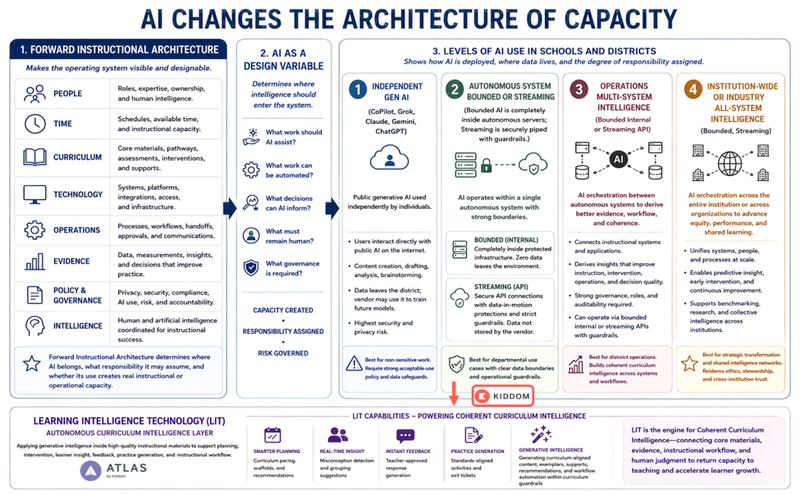
At the broadest level, educational leaders engage in what might be called Forward Instructional Architecture.
Forward Instructional Architecture is not a software category. It is not artificial intelligence. It is the discipline of designing how people, time, curriculum, technology, operations, systems, and intelligence work together across an educational institution.
Its purpose is coherence through orchestration, reducing the cognitive, operational, and coordination burden placed on humans by increasingly complex educational systems.
Within that leadership framework, artificial intelligence can begin operating at multiple organizational levels.
The broadest future category is Institutional Intelligence.
Institutional Intelligence refers to intelligence operating between enterprise systems and departments. Finance, human resources, payroll, procurement, facilities, transportation, communications, compliance, safety, and instructional operations can increasingly be coordinated through intelligence capable of reasoning across organizational workflows rather than within isolated applications.
Institutional Intelligence focuses on operational coherence across the enterprise. All the systems. Other industries are already doing this.
Within that larger environment sits Coherent Curriculum Intelligence.
Coherent Curriculum Intelligence is the instructional orchestration layer connecting curriculum systems, learning management systems, assessment platforms, intervention systems, content resources, learner evidence, instructional workflow, instructional time, and supporting instructional technologies into a coherent instructional environment.
Rather than asking educators to coordinate those systems manually, the system increasingly coordinates them around the architecture of the adopted curriculum.
Within Coherent Curriculum Intelligence sits an even more focused technology layer:
Learning Intelligence Technology (LIT).
Learning Intelligence Technology applies bounded generative artificial intelligence inside high-quality instructional materials. It supports planning, intervention, learner insight, feedback, practice generation, and instructional workflow while remaining aligned to the curriculum's structure, sequence, standards, and instructional intent.
These layers are related but distinct.
Forward Instructional Architecture provides the leadership discipline. This is not a “model” ideal or a motto like being “Future Ready.” It is a working construct, something not fixed.
It’s what all the administrators in any educational institution now need to become familiar with because it is the first organizational architecture designed specifically for dynamism, acknowledging that people, systems, workflow, curriculum, time, operations, and intelligence are not static assets but living elements in continuous motion.
It is the first idealized organizational architecture built on the recognition that both the humans and the systems of schooling are continually moving, adapting, interacting, and changing in relation to one another. Curriculum changes. Learner needs change. Time shifts. Technologies evolve. Policies change. Staffing changes. Evidence emerges. Intelligence operates across the environment. Forward Instructional Architecture exists to intentionally design and orchestrate coherence within that motion.
Institutional Intelligence provides enterprise orchestration. It coordinates intelligence, workflow, data, decisions, resources, and operations across departments and enterprise systems. This is not consumer AI, it is AI within and across an institution’s own data. Elements of this sort of operation can be seen within the documents, spreadsheets, slides, and email by users of Copilot by Microsoft or in Google environments by Claude.
Coherent Curriculum Intelligence provides instructional orchestration within the instructional silo of districts and schools. It coordinates intelligence across instructional systems, applications, learner evidence, workflow, time, and curriculum resources.
Learning Intelligence Technology provides curriculum-embedded intelligence. It applies bounded generative intelligence within high-quality instructional materials to support planning, insight, feedback, practice generation, and instructional workflow.
The hierarchy matters because conversations about AI in education often collapse these very different functions into a single discussion.
They are not the same thing.
The graphic below illustrates the relationship.
What Coherent Curriculum Intelligence Is Not
Coherent Curriculum Intelligence is not another name for digital content. It is not an LMS, an assessment platform, a content repository, an intervention product, an AI chatbot, or a dashboard.
Each of those categories already exists, and each performs a recognizable function.
Coherent Curriculum Intelligence is different because it is the instructional orchestration layer through which curriculum, assessment, learner evidence, intervention, workflow, instructional time, and supporting instructional systems operate as a coherent environment. Rather than asking educators to coordinate those elements manually, the system coordinates them around the adopted curriculum architecture.
Think of Coherent Curriculum Intelligence as an AI that organizes many different instructional systems and applications into a coherent whole.
Learning Intelligence Technology is the technology category that makes the curriculum-intelligence portion of that environment possible. LIT operates inside a curriculum. It uses curriculum structure, assessment, and learner evidence to support planning, surface insights, generate feedback and practice, and automate defined portions of instructional work.
This is not simply a larger collection of features.
It is a new design pattern.
Why This Changes the Meaning of Curriculum Adoption
When a district or state refers to curriculum adoption, the term typically means the formal selection of the core instructional program teachers will use as the foundation of teaching and learning for multiple years.
An adoption generally includes scope and sequence, units, lessons, assessments, teacher guides, student materials, pacing, standards alignment, professional learning, and implementation expectations. In many states, particularly textbook-adoption states, the terms curriculum adoption, instructional materials adoption, and textbook adoption have often been used almost interchangeably.
That history shapes how education leaders hear the word curriculum.
Many still picture books, chapters, teacher manuals, student materials, and supplemental resources. Intervention systems remain separate. The LMS is separate. The gradebook is separate. Analytics and workflow systems are separate.
A district adopting Coherent Curriculum Intelligence is adopting something considerably larger than instructional materials.
It is adopting an operational and implementation layer around the curriculum.
This directly addresses one of the most familiar frustrations in public education:
"We adopted great curriculum. We cannot implement it consistently."
Under the old model, a curriculum adoption delivered materials and expectations to the institution. The institution then depended upon teachers, coaches, principals, and curriculum leaders to manually create coherence around them.
Under the new model, adoption can include curriculum, implementation workflow, embedded assessment, evidence, intervention signals, instructional recommendations, and continuity within one operating architecture.
The curriculum adoption therefore becomes more than the purchase of instructional content.
It becomes the adoption of an instructional architecture supported by institutional and instructional intelligence.
That is the leap.
Why High-Quality Instructional Materials Matter
Curriculum is the organizing anchor of this category because it provides the common architecture around which assessment, evidence, intervention, instructional workflow, and intelligence can be coordinated.
Curriculum is not simply a collection of resources.
It has scope, sequence, units, lessons, instructional methods, assessment, standards alignment, anticipated misconceptions, teacher guidance, and a defined progression through knowledge and skill.
When assessment originates from the same unit design, intervention recommendations arise from the same instructional framework, and evidence feeds back into the same sequence, teachers do not have to reconcile competing systems continually.
The instructional response is generated from within the structure teachers and students are already using.
Without coherent curriculum, intelligence fragments.
Recommendations may be technically interesting but instructionally unrelated. Data may be accurate but operationally unusable. Teacher attention disperses across systems. High-quality instructional materials provide the architecture that keeps intelligence attached to the actual work of teaching and learning.
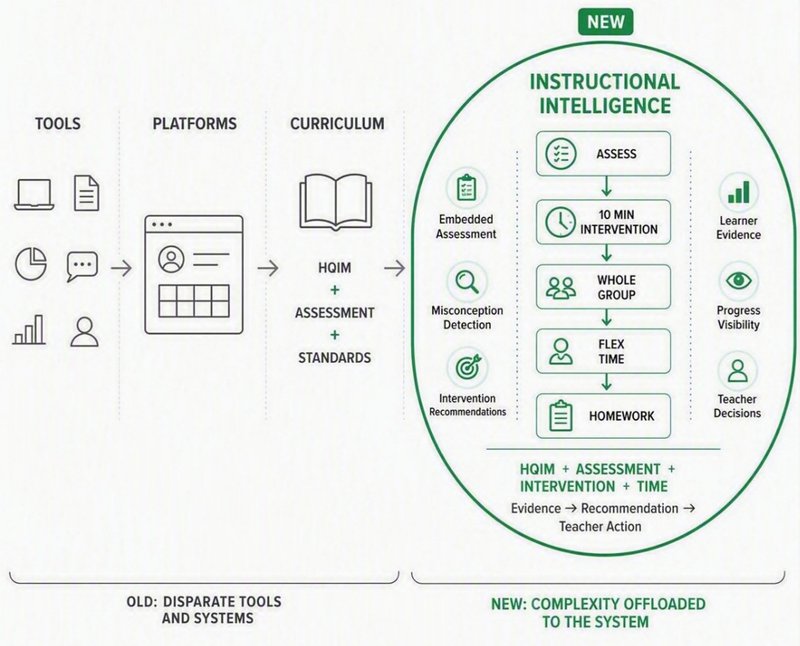
Educational technology has progressed through a recognizable sequence.
The first generation digitized individual tools.
The next generation created platforms.
The emerging generation is different. Coherent Curriculum Intelligence serves as an instructional orchestration layer connecting curriculum systems and courseware, assessment systems, content applications and libraries, learner evidence, intervention, instructional workflow, instructional time, and supporting instructional systems into a coherent operating environment. Learning Intelligence Technology supplies curriculum-embedded intelligence within that larger architecture.
The movement is therefore not simply:
Paper to digital.
Or even:
Tools to platforms.
It is disconnected functions becoming coordinated instructional intelligence.
This is a graphic of Learning Intelligence Technology, a new product category:
What Happens Inside the System
At its core, Coherent Curriculum Intelligence connects several families of operational capability.
Curriculum Architecture
The system begins with high-quality instructional materials, standards alignment, sequenced learning pathways, units, lessons, and a coherent progression of knowledge and skill.
Embedded Assessment and Evidence
Assessment occurs within instruction. Learner responses produce usable evidence tied to the specific curriculum, lesson, standard, and instructional objective.
Responsive Instruction
The system supports whole-group instruction while helping teachers identify when learners need intervention, additional practice, flexible grouping, enrichment, or another explanation.
Learning Intelligence Technology
Within the curriculum, LIT can provide:
- Smarter Planning
- Real-Time Insight
- Instant Feedback
- Practice Generation
- Generative Intelligence
all within curriculum guardrails.
Instructional Time
Recommendations become more useful when they are connected to the actual time available. Intervention can become an executable instructional action rather than simply another suggestion.
Teacher Decision Support
The system does not eliminate professional judgment. It supports that judgment by identifying patterns, presenting evidence, suggesting groups, recommending next steps, and making learning more visible. The teacher remains the decision-maker.
These elements work together rather than existing as separate systems.
That connected operation is the defining difference.
The Labor Breakthrough
Most conversations about educational technology focus almost exclusively on achievement.
Achievement matters, but Coherent Curriculum Intelligence presents another breakthrough that may prove equally consequential: labor.
Schools have historically attempted to manage learner variability by increasing teacher responsibility.
More differentiation meant more lesson construction.
More evidence meant more analysis.
More intervention meant more planning and grouping.
More accommodations meant more revisions.
The institution's response to complexity was largely to add work.
Coherent Curriculum Intelligence reverses that pattern.
Instead of responding to learner variability by continually enlarging teacher workload, it allows the system to absorb defined portions of instructional management.
The breakthrough is a reduction in instructional management overhead.
The First Visible Example of the Category
Every major educational technology category becomes recognizable through early examples. Learning management systems had pioneers. Student information systems had pioneers. Digital curriculum had pioneers. The product makes the category visible before the market has fully developed the language to describe it.
Coherent Curriculum Intelligence is beginning to show the same pattern.
Its defining characteristic is not the presence of artificial intelligence by itself.
The defining characteristic is coherence. Intelligence operates within high-quality curriculum and connects evidence, intervention, workflow, time, and teacher action without breaking the instructional architecture into another collection of unrelated tools.
Learning Intelligence Technology provides the curriculum-embedded layer within that operational category.
Kiddom demonstrates how high-quality instructional materials can become more than static or digitized curriculum. Curriculum can carry embedded assessment, surface learner evidence, support intervention, guide teacher planning, generate aligned practice, assist with feedback, and reduce manual workload while preserving the integrity of the adopted instructional program.
Kiddom is the first visible market example of Learning Intelligence Technology operating within the larger category of Coherent Curriculum Intelligence.
Coherence Is the Breakthrough
The education market will undoubtedly produce more AI tools, assistants, generators, analytics engines, and automation features. Many will be useful. Some will create entirely new forms of fragmentation by adding still more systems, recommendations, screens, and decisions for educators to reconcile.
Coherent Curriculum Intelligence establishes a more demanding standard.
The question is not simply whether a system contains AI.
The question is whether intelligence is operating within coherent curriculum, drawing from relevant learner evidence, producing instructionally aligned responses, respecting available time, reducing teacher workload, and connecting with the larger instructional environment.
That is what distinguishes a collection of intelligent features from an intelligent instructional system.
Education has always had human variability.
What education has not previously possessed is the capacity to coordinate those elements continuously, coherently, and at institutional scale.
Now it does.
The teacher should never have been required to hold up the ceiling alone.
Coherent Curriculum Intelligence is the instructional operating architecture through which the system can finally begin carrying its share of the weight.
Its focus is instruction: curriculum, assessment, learner evidence, intervention, instructional workflow, and time.
Over time, that instructional intelligence may connect to broader forms of Institutional Intelligence coordinating district-wide enterprise systems and operations.
Coherent Curriculum Intelligence represents the instructional portion of that larger evolution.
***