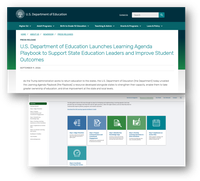
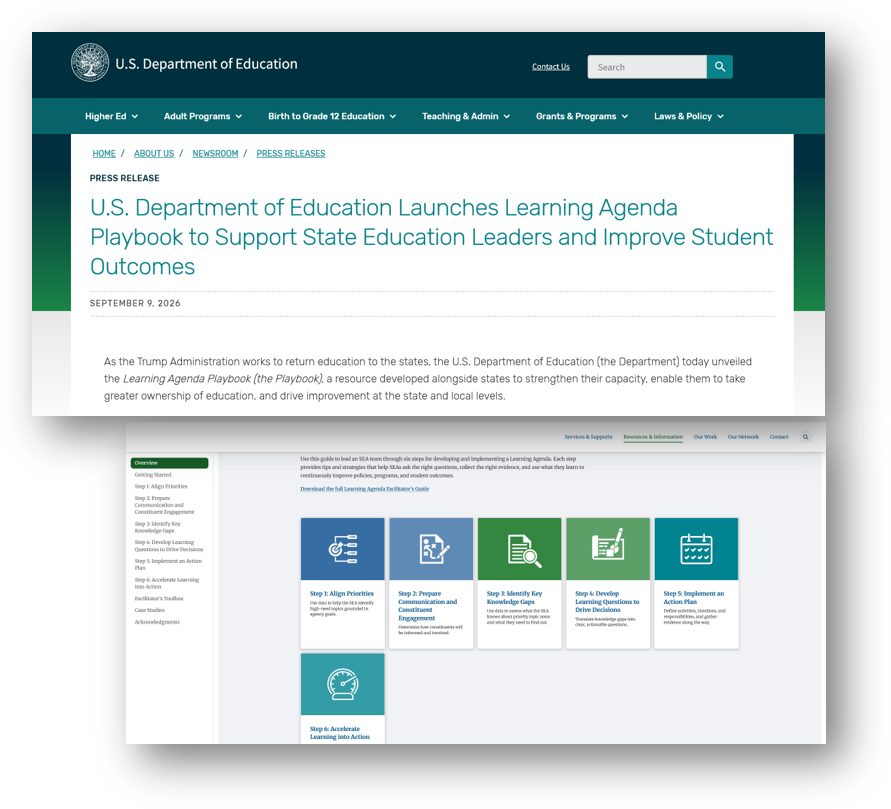
The U.S. Department of Education officially released the Learning Agenda Playbook, a new framework designed to help State Education Agencies (SEAs) identify challenges, build evidence, and make more strategic decisions about education policy and investments. While the announcement is new, the work itself is already underway in eight states that have spent months piloting the approach.
The Department developed the Playbook in partnership with Arkansas, Georgia, Idaho, Kansas, New Hampshire, Tennessee, Utah, and Wisconsin, which participated in testing and refining the framework before its public release. According to the Department, the goal is to help states move beyond measuring activity and instead focus on understanding which initiatives are producing meaningful results for students.
The timing is notable.
As states grapple with educator shortages, literacy challenges, student well-being concerns, evolving accountability systems, and the emergence of artificial intelligence in education, leaders are increasingly looking for ways to connect evidence, policy, and action. The Learning Agenda Playbook is intended to provide that structure by helping agencies identify priority questions, gather relevant evidence, and use the findings to guide future decisions.
From Compliance to Continuous Learning
For decades, state agencies have operated largely through strategic plans, accountability systems, grants, and reporting requirements. The Learning Agenda model introduces a different approach.
Rather than beginning with programs, states begin with questions.
What is improving literacy outcomes?
Which teacher-retention strategies are actually working?
Why are certain student support initiatives succeeding in some regions but not others?
What evidence should guide the next major investment?
The Playbook helps agencies organize those questions into a multi-year framework and align research, evaluation, stakeholder engagement, and decision-making around answering them.
In announcing the initiative, the Department emphasized that the objective is not more data collection but better evidence for better decisions. The Playbook includes a Facilitator's Guide, implementation toolbox, Learning Agenda template, and a Capacity Continuum tool that helps agencies assess their current capabilities and identify areas for growth.
Georgia Focuses on the Teacher Pipeline
Among the participating states, Georgia has emerged as one of the most visible examples.
The Georgia Department of Education was selected for the Learning Agenda initiative based on its work to strengthen teacher recruitment and retention, including its Teach in the Peach campaign. State officials indicated that participation will help identify effective workforce practices, build research structures, and create cross-functional teams focused on growing the educator pipeline.
In practical terms, Georgia's Learning Agenda work represents a shift from simply tracking hiring numbers toward understanding which recruitment and retention strategies are delivering measurable results and why.
Wisconsin Uses the Framework to Strengthen Strategic Planning
Wisconsin appears to be taking a different approach.
According to reporting surrounding the Playbook release, Wisconsin leaders are using the Learning Agenda process to add capacity and structure to the state's existing strategic planning efforts. Rather than creating another standalone initiative, the framework is being layered onto existing priorities as a way to improve evidence gathering and organizational learning.
That may ultimately become one of the most important features of the model. Instead of introducing additional programs, Learning Agendas are designed to improve how agencies make decisions about the programs they already operate.
Breaking Down Agency Silos
During a recent Council of Chief State School Officers collaborative session, leaders from Kansas, Georgia, Utah, and Wisconsin discussed how Learning Agendas can help state agencies build capacity for data use, prioritize goals, and develop operational strategies to improve student outcomes.
For many state agencies, that challenge is significant.
Curriculum teams, assessment divisions, school improvement offices, finance departments, technology groups, and accountability units often operate independently, each producing valuable information but not always connecting those insights to a common strategy.
One early lesson from participating states appears to be that Learning Agendas help bring those divisions together around shared questions and common priorities rather than isolated initiatives.
What Are States Studying?
The eight pilot states applied the Learning Agenda framework to a diverse set of challenges, including:
Literacy improvement
Teacher recruitment and retention
School improvement strategies
Early learning initiatives
School leadership development
Student well-being
Use of intermediary organizations and support structures
Rather than beginning with available programs or existing reports, states reportedly started by identifying outcomes they wanted to improve and then determining what questions and evidence would help guide decisions.
A Potential Shift in How States Operate
The release of the Learning Agenda Playbook may ultimately signal something larger than a new federal resource.
It suggests the emergence of a different model of state education leadership, one built around continuous organizational learning rather than periodic planning cycles. Instead of measuring success primarily through activities completed or funds distributed, Learning Agendas encourage agencies to continuously ask whether investments are producing the desired outcomes and what evidence should inform the next set of decisions.
The most intriguing question now is whether the eight pilot states represent the beginning of a broader national movement.
If more states adopt Learning Agendas, education agencies may increasingly function less as compliance-driven bureaucracies and more as learning organizations: institutions designed to identify problems, evaluate evidence, refine strategy, and improve continuously.
For a K-12 sector facing rapid technological change, workforce pressures, and rising expectations for student success, that capability could prove as important as any individual initiative.
And that may be the real story behind today's federal announcement.
The Playbook is new.
The transformation it represents may already be underway.