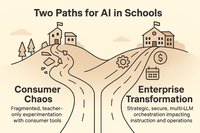
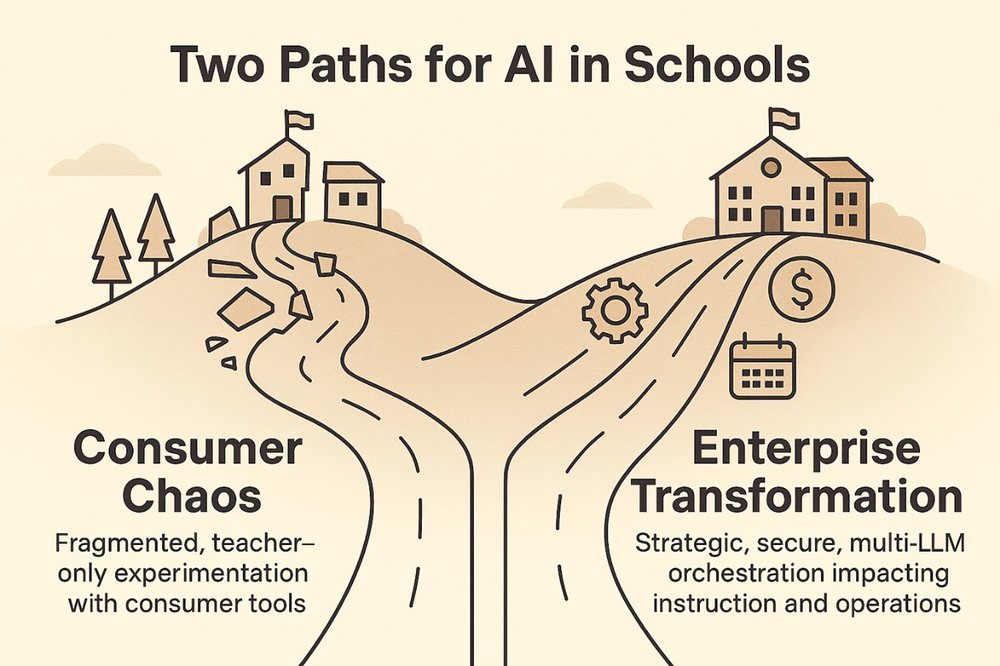
Little Rock, AR — As districts tiptoe into AI by “letting teachers experiment” with consumer tools like ChatGPT or Gemini, they risk locking themselves into fragmented pilots that never scale—and never address the hardest problems in schooling. All while concerning themselves with “AI Literacy” when a whole different set of skills will need to be learned when a different approach is finally realized both students and teachers need to be “AI Fluent.”
A new wave of education-specific, enterprise AI orchestration—exemplified by a company named Airia—points to a different future: an Omni-AI layer that is model-agnostic, secure by design, and capable of transforming instruction and operations (finance, HR, transportation, compliance, scheduling) in one governed platform -- their Brainfreeze offering.
The difference is stark -- AI-as-tool to AI-as-Infrastructure.
Airia’s Launch of Brainfreeze Signals the End of Single-Tool Thinking
Airia’s BrainFreeze was introduced in early 2025 as a complete AI platform for K-12 with ready-to-use assistants, secure student AI spaces, SIS/LMS integrations, and district-level guardrails, offered free for teachers and low per-user pricing for districts—explicitly designed to scale beyond classroom pilots. Unlike consumer chat apps, BrainFreeze’s orchestration sits across multiple LLMs and district data, bringing consistent controls and governance to every interaction.
Critically, BrainFreeze emphasizes granular safety: role-based access, age-specific filtering, automated PII protection, subject-specific guardrails, and alignment to district policy—paired with public statements about FERPA/COPPA/GDPR compliance and enterprise certifications such as SOC 2 and ISO 27001. This is the difference between an education platform and a consumer app with classroom ambitions.
Why Consumer Chaos Fails School CIOs
Districts that rely on consumer LLMs face shadow AI—unsanctioned tools with inconsistent policies, unknown data handling, and little auditability. Enterprise security leaders warn that AI adoption without platform-level governance creates blind spots, raises leakage risk, and fractures policy enforcement across models and clouds. Operationally, swapping LLMs isn’t “plug and play.”
Differences in tokenization, context windows, output formats, and instruction handling can break workflows, inflate costs, or degrade quality. Districts that assemble consumer tools piece-by-piece discover the hidden migration tax when a provider throttles or changes policies. The enterprise orchestration layer—the spine of modern AI app stacks—exists precisely to manage these cross-model complexities and provide failover when one model stumbles.
Omni-AI: A Model-Agnostic, District-Owned Control Plane
The strategic move is an Omni-AI control plane: vendor-neutral, multi-LLM, governed by the district, and integrated with core systems. Airia positions its platform as security, orchestration, and governance for AI agents, with AWS-validated partnerships and Bedrock integrations—evidence of enterprise-grade deployment paths districts can trust. This architecture reduces single-vendor dependency, enables routing to the best model per task, and codifies policy once, enforce everywhere. Education-specific platforms further deliver no-code assistant builders for teachers and staff, plus out-of-the-box Google Workspace and Microsoft 365 integrations—lowering time-to-value while preserving centralized governance. That is how AI moves from isolated classroom use to district-wide impact across instruction, master scheduling, finance, HR, transportation, and compliance reporting.
Security and Compliance Are Not Optional
K-12 operates under FERPA/COPPA/CIPA constraints, and any AI touching student records must be governed accordingly. Schools need vendors designated as “school officials” under DPA terms, with explicit limits on data use and disclosure. Enterprise AI platforms—and their orchestration policies—are built to meet these requirements and to produce audit trails that stand up to scrutiny. Consumer tools seldom provide district-level governance features necessary for compliance at scale. Security leaders add: multi-model, multi-cloud AI must include AI security posture management, prompt-injection detection, and runtime policy enforcement. Without an integrated platform, districts face rising risk from indirect prompt injection, data oversharing, and agent misbehavior—risks that only grow as AI spreads beyond classrooms into back-office operations.
Hard-Hitting Reality: Consumer AI Is a Distraction
The narrative that “teachers should just try consumer AI” misses the point. Classroom-only pilots neither deliver systemic gains nor protect institutional data. A district that does not establish an Omni-AI governance layer will:
• Multiply shadow AI risk and FERPA exposure.
• Suffer from fragmented analytics and inconsistent instructional experiences.
• Struggle to scale or switch models when downtime or policy changes hit.
• Miss transformation in finance, HR, transportation, compliance, and scheduling that requires orchestration, integrations, and enterprise security.
What BrainFreeze/Airia Brings
Learning Counsel’s research review of the Brainfreeze/Airia offerings show they have brilliantly hit ever major point necessary to partner with education. For non-technical people, it’s only important to know that the solution is fully loaded, while being as simple as possible for teachers, learners and staff. The fact that it is not exactly as simple as just a free open text box you type into and get endless feedback through doing better scripting only, should be considered immaterial since it is exactly that elegant simplicity putting schools at risk even when a couple of accommodating niceties are promised.
For the technical reader:
The difference is that when a district looks they will understand that Airia built these aspects that are uncontestably important to safety and security of school data.
- Model-agnostic, multi-LLM orchestration to prevent vendor lock-in and route tasks to the best model.
• Resilience and failover when an LLM is throttled or down; orchestration manages cross-model quirks.
• Education-specific integrations (SIS/LMS, Google/Microsoft) and secure student AI spaces for instruction.
• Granular safety and compliance (role-based access, age filters, PII protection, FERPA/COPPA/GDPR alignment, SOC 2/ISO signals).
• Enterprise-grade security posture and audited governance; AWS-validated pathways for scale. This is the same level Airia utilizes for banks and healthcare customers.
• District-friendly economics (free teacher tier, low per-user pricing) to accelerate governed adoption.
Urgent: CIO Checklist for AI Adoption
- Does the platform support multiple LLMs and allow failover?
- Is there centralized governance for security, compliance, and policy enforcement?
- Are integrations available for SIS, LMS, and productivity suites?
- Does the vendor provide FERPA/COPPA/GDPR compliance and enterprise certifications?
- Can the platform scale beyond instruction to operations like HR, finance, and scheduling?
- Are there guardrails for age-appropriate use and PII protection?
- Is pricing structured for district-wide adoption without hidden migration costs?
***