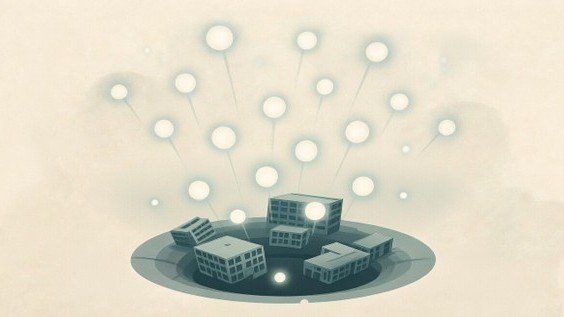
A new whitepaper by the Learning Counsel discusses the structural transformation of the American K-12 education system towards decentralized, localized, and personalized alternatives in response to societal changes and declining trust in centralized institutions.
Here are the highlights:
Predictive Analysis of Education's Future
- The traditional centralized public school system is projected to face significant challenges, leading to steep declines in student enrollment by 2040.
- Odds are below 35% for districts retaining current form by 2040.
- Structural headwinds against centralized education are substantial, with a momentum weight of 7.5 out of 10.
- Major thematic threads indicate a shift towards disaggregation, decentralization, and re-segregation in education because it is already happening across society.
The Big Why: The Rise of Techno-Feudalism
- A new societal structure is emerging, characterized by decentralized, self-governing educational units.
- Centralized systems are losing legitimacy, prompting a retreat to smaller, autonomous networks.
- Both left and right political groups are forming affinity-based units in response to centralized failures.
- Techno-feudalism involves AI-corporate power fragmented into small, high-trust units.
- The economic landscape is experiencing significant changes, including a rise in local food production and trade-based clusters.
- Rise of farm-direct sales and local food co-ops, with local food production expected to account for 15–25% of consumption by 2040.
- Neighborhood atomization and trade-based clusters emerging, with 40–60% of trades occurring in local guilds.
- Interest surging in trades and applied skills, with search volume for trades up 35%+ and trades expected to dominate entry-level pathways (60–70%).
- Decline of commercial real estate and out-migration from cities.
Fragmentation and Decentralization in Education
- The shift towards smaller, adaptive educational units will be a response to the failures of centralized institutions and societies restructuring to nearly 60% flexible/work-from-home employment for parents.
- Groups on both political sides are creating self-governing networks for education.
- The trend reflects a macro-movement towards local sovereignty and self-governance in education.
Impact of AI on Education Structure
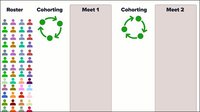
- AI is driving a significant transformation in educational logistics and structure -- particularly the newest form of it which is Time AI for auto-cohorting all learning and teaching. This new AI is set to disrupt the traditional model while also allowing cross-sharing of both teachers and resources across multiple campuses and satellite schools in new hybrid formulations.
- The shift from centralized AI chatbots owned by a few major corporations to decentralized local models is underway and will further fuel the schooling decentralization.
- A super-decentralization of spaces used and how curriculum becomes “liquid” to adapt in ultra-personalized ways allows for customized learning experiences and entirely new dynamics.
Today’s Indicators in School Enrollment
- Public school enrollment is declining, while alternative education models are experiencing significant growth.
- Public school enrollment projected to drop from 45.2 million in 2025 to 28.5 million by 2030.
- Microschools and homeschooling are growing rapidly, with microschools expected to reach 3 million students by 2030.
- Public charter schools are projected to grow to 5 million students by 2030.
- School choice acceleration, with 40–50 states expected to have full choice programs by 2040.
This white paper predicts that by 2040, centralized educational systems are expected to dissolve unless they undertake significant reform of structure in their delivery, turning non-traditional and towards AI-enabled pace-based and teacher-intersected logistics models. Traditional models will be replaced by distributed resilience, with a strong momentum score of 7.5/10 indicating that clear direction towards decentralization.
***