

Executive Summary:
Current initiatives to significantly reduce or eliminate instructional screen use are well-intentioned but structurally incomplete. They address a visible classroom input (devices) while leaving unchanged the underlying instructional system that generates overload conditions for teachers.
In heterogeneous classrooms with wide variance in student readiness, removing digital tools increases reliance on whole-group, teacher-mediated instruction and further constrains differentiation capacity. The central constraint in modern schooling is not technology use, but finite teacher instructional time relative to learner variability.
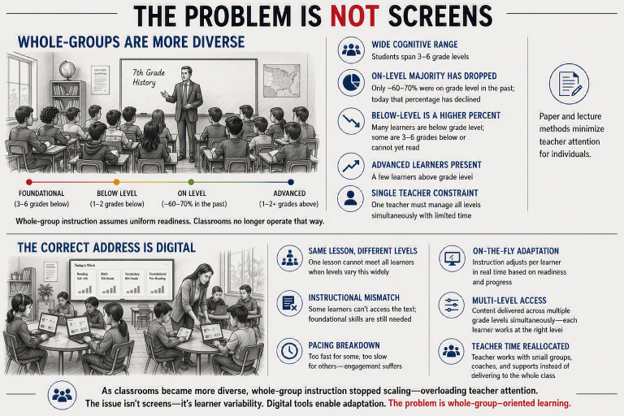
1. Context: The Structural Shift in Classroom Composition
Contemporary K–12 classrooms are characterized by significantly higher instructional heterogeneity than in prior decades. While classrooms have never been perfectly uniform, the range of academic readiness within a single grade-level classroom has widened substantially, driven by a combination of demographic change, inclusion policy, learning recovery gaps, and increased identification of learning differences.
Historically, mid-20th-century classroom structures were designed around a narrower distribution of readiness. Standardized tracking, more selective special education placement, and lower rates of multilingual enrollment in many districts contributed to classrooms where students were more likely to be clustered within a narrower band of academic performance. Instructional models assumed that most students in a given grade could move through grade-level content at roughly comparable pacing.
That assumption no longer holds.
Current data trends indicate a significantly more variable instructional environment:
- Learning variability: National assessment data (NAEP) consistently shows widening achievement dispersion within grade levels, particularly in reading and mathematics, with substantial proportions of students performing below and above grade-level expectations within the same cohort.
- English learners: Public school English learner enrollment in the U.S. has increased to approximately 10–11% of total enrollment, with much higher concentrations in many districts, requiring simultaneous content instruction and language acquisition support.
- Special education identification: Roughly 15% of U.S. public school students now receive special education services under IDEA, requiring individualized instructional planning and accommodations embedded within general education classrooms.
- Post-pandemic learning variability: Multiple large-scale studies (including NWEA and state assessment reports) indicate that COVID-era disruptions produced widened learning gaps, with some cohorts showing multi-year variance in achievement levels within a single grade band.
In practice, this means a single classroom may contain students operating several grade levels below proficiency, students at grade level, and students above grade level—all within the same instructional period and subject area.
This stands in contrast to earlier instructional eras where variability existed but was less extreme, and where ability grouping, tracking systems, or more limited inclusion frameworks reduced the breadth of simultaneous instructional demands placed on a single teacher.
The result is a structural shift: the modern classroom is no longer a relatively homogeneous instructional unit, but a high-variance learning environment in which age-based grouping no longer functions as a reliable proxy for readiness
2. Constraint Analysis: Teacher Instructional Capacity
The primary limiting factor in current instructional models is not curriculum or content availability, but teacher instructional time.
Teachers are expected to simultaneously:
- Deliver core instruction to a full class cohort
- Differentiate instruction across multiple readiness levels
- Provide remediation and acceleration
- Manage classroom behavior and engagement
- Conduct ongoing formative assessment
- Document progress and compliance requirements
- Communicate with families and support services
This cumulative workload exceeds what can be reasonably supported through direct, synchronous instruction alone.
Policy responses that reduce instructional tooling without redesigning instructional structure tend to increase dependence on whole-group delivery and therefore increase pressure on teacher time.
Technically, the operating environment has structurally changed, but the instructional model of whole-groups-by-age has not.
Historical vs. Contemporary Classroom Structure
| Dimension | Mid-20th Century Classroom (Approx. 1950–1980) | Contemporary Classroom (2020s–Present) |
|---|---|---|
| Instructional variability within grade | Generally narrower academic range within a classroom due to tracking, ability grouping, and more selective inclusion | Wide variance; classrooms commonly include students performing multiple grade levels below and above standard expectations |
| English learner population | Low in many districts; limited ESL infrastructure nationally | ~10–11% of U.S. public school enrollment; much higher in many urban/suburban districts |
| Special education inclusion | More segregated service models; fewer students in general education classrooms full-time | ~15% of students receive IDEA services; majority served in inclusive general education settings |
| Instructional model dominance | Whole-group instruction with periodic grouping; more standardized pacing | Whole-group instruction still dominant, but layered with mandated differentiation, inclusion supports, and individualized plans |
| Pacing expectation | More uniform progression within classrooms (age + tracking alignment) | Highly variable pacing within a single classroom (often multiple grade-level equivalencies simultaneously) |
| Teacher role load | Primarily content delivery + classroom management | Content delivery + differentiation + compliance documentation + intervention management + family communication + SEL + assessment |
| Instructional support tools | Textbooks, chalkboard/overhead projector, paper-based differentiation | Digital platforms, adaptive learning tools, AI-enabled supports, LMS systems, mixed-modal content delivery |
| Assessment cycle | Periodic summative assessment (unit, term-based) | Continuous formative + summative cycles, often tied to intervention requirements and data reporting |
| Expectation of personalization | Limited expectation; differentiation less formally mandated | Formal expectation of individualized instruction and documented differentiation for diverse learners |
| Primary constraint on instruction | Content access and standardized curriculum delivery | Teacher instructional time relative to learner variability |
3. Role of Instructional Technology
Instructional technology, including digital learning platforms and AI-assisted tools, does not create classroom heterogeneity or instructional complexity. These conditions predate digital systems and are driven primarily by demographic diversity, inclusion policy, language diversity, and academic variability within age-based grade structures.
The functional role of instructional technology is to enable:
- Asynchronous content acquisition
- Self-paced practice and review
- Adaptive feedback loops
- Translation and accessibility support
- Automated formative assessment support
When used in this capacity, technology reduces reliance on continuous whole-group instruction and frees teacher time for high-value instructional interactions.
4. Risk of Screen Elimination Policies
Policies that broadly reduce or eliminate classroom screen use without corresponding structural redesign have several predictable effects:
- Increased dependence on whole-group instruction
- Reduced capacity for individualized pacing
- Increased teacher workload associated with remediation and differentiation
- Reduced responsiveness to wide variance in student readiness
- Greater instructional inefficiency in heterogeneous classrooms
These outcomes occur not because screens are inherently necessary, but because current instructional models lack alternative mechanisms for scaling individualized learning.
5. Instructional Mismatch: Immediacy and Feedback Loops
Modern learners operate in environments characterized by immediate feedback systems (search, communication, AI-assisted tools, and interactive media). Traditional classroom structures, by contrast, often rely on delayed feedback cycles governed by pacing guides, grading timelines, and synchronous instruction.
This creates an operational mismatch between external learning environments and internal school systems. The issue is not attentional capacity alone, but the latency of instructional feedback relative to contemporary digital experience.
6. Instructional Model Implications
The underlying challenge is not screen usage, but instructional architecture. The dominant model assumes:
- Age-based grouping implies relative academic homogeneity
- Whole-group instruction is the primary delivery mechanism
- Teachers serve as the central conduit for content delivery
These assumptions no longer align with observed classroom conditions.
A more functional model distinguishes between:
- Asynchronous foundational learning (independent or system-mediated)
- Targeted teacher-led instruction (small group or individual)
- Whole-group instruction (shared experience, discussion, demonstration, and synthesis)
In this model, whole-group instruction becomes episodic rather than primary.
7. Implications for Policy and Practice
Effective policy responses should prioritize instructional capacity rather than device restriction. Key considerations include:
- Expanding mechanisms for individualized pacing within the school day
- Supporting hybrid instructional models that reduce dependence on whole-group delivery
- Leveraging adaptive systems to offload routine instructional tasks
- Reallocating teacher time toward diagnostic, relational, and high-complexity instruction
- Redefining classroom structure to reflect learner variability rather than assumed homogeneity
8. Conclusion
The current debate over screens risks misidentifying the primary constraint in modern education.
The central issue is not the presence of technology in classrooms, but the mismatch between instructional design and learner diversity.
Policies that reduce instructional tools without addressing structural conditions increase reliance on an already overextended instructional model.
The result is not simplification of teaching, but amplification of its most difficult constraints.
The core challenge is therefore not to eliminate screens, but to redesign instructional systems so that teachers are no longer required to perform beyond the limits of sustainable human instructional capacity.