By design, K–12 schools were built for a world of scarce information and stable jobs. AI upends both The bottleneck is the operating system of schooling—especially how we define the teacher’s role.
Teachers do want less clerical work and more human interaction. They fear a loss of professional identity, which means leaders aren’t really leading the refinement of teaching to the essential human parts. They’re leaving the workflow the same as it’s always been.
The Hidden Constraint: A System Built for Whole‑Group, Teacher‑Centric Delivery
For more than a century, schooling has centered on a teacher‑as‑primary‑source model: one adult curates content, delivers it to a whole group, and verifies individual understanding via standardized tasks. AI destabilizes each step—curation, delivery, and verification—by making high‑quality explanations, translations, exemplars, auto-grading and feedback widely available on demand. When knowledge is decentralized and co‑created with machines, the teacher’s traditional status as the exclusive conduit of content is structurally undermined. This is not a culture war; it’s a systems clash. Research consistently shows that when technologies challenge established roles and workflows, educators hesitate or resist until purpose, policy, and professional identity are re‑anchored. [michiganvirtual.org]
That resistance is visible in current data: while teacher use of AI is rising, a sizable minority still holds negative views and many report insufficient support and governance to use AI responsibly. One synthesis notes 21% of teachers hold negative attitudes about AI’s role, and uneven adoption maps closely to where guidance and training are thin. The consequence is predictable: AI’s potential shows up as workload risk and role confusion, not instructional leverage. [aiprm.com], [rand.org] [michiganvirtual.org]
Why “Cheating Panic” Is a Structural Signal—Not a Moral Failure
The headline fear in schools isn’t automation; it’s academic integrity. Surveys in 2025 found 78% of educators are worried about AI‑enabled cheating and a majority have already encountered it. Higher‑ed and mixed‑audience surveys echo the same pattern: students say AI makes cheating easier and faculty anticipate more integrity challenges ahead. [thejournal.com] [insidehighered.com], [edsource.org]
Look deeper and you’ll see the signal: our assessment model was designed for a pre‑AI world.
When evaluation rests on independent text production and fixed‑answer tasks, a general‑purpose text generator collapses the measurement. Ambiguity follows about what counts as help vs. what counts as dishonesty, with faculty articulating a “hierarchy of GenAI plagiarism” and calling for clearer policies. Instructors and students alike report that AI can shortcut authentic learning even as it supports brainstorming and drafting, indicating a design gap between means (AI‑assisted creation) and ends (demonstrated mastery). [frontiersin.org] [luminafoundation.org], [turnitin.com]
This is a structural incompatibility, not a character flaw. Cheating panic is the canary in the coal mine telling us that assessment, pacing, and role expectations no longer match the tools students actually have.
The Teacher Role: From “Deliverer & Detective” to “Human Catalyst/Expert, Diagnostician, & Guide ”
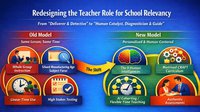
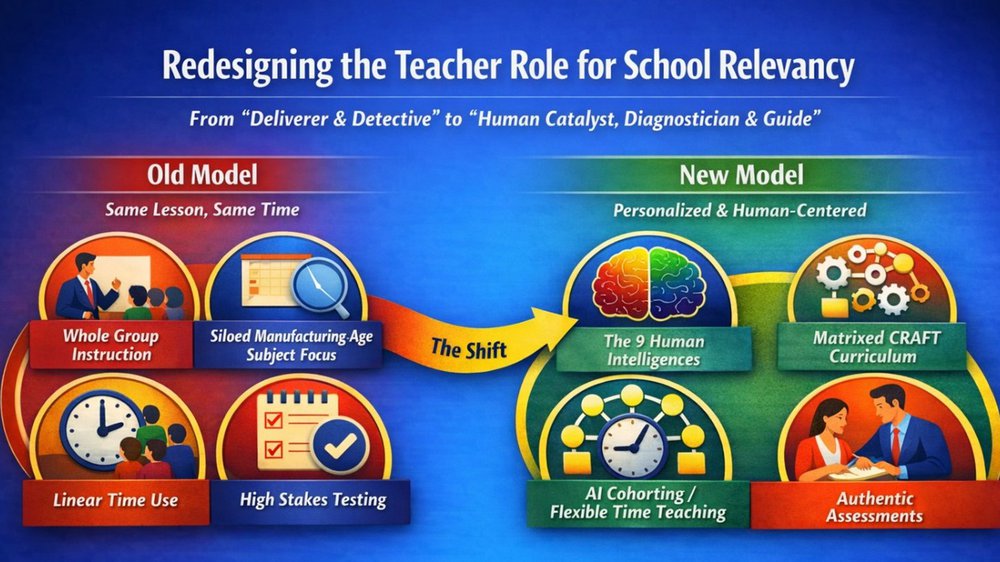
For over a century, schools have defined teachers as (1) deliverers of content and (2) detectives who catch misuse. But in an AI‑rich environment, the teacher’s highest‑value work shifts dramatically. The modern role becomes that of a Human Catalyst, Expert Diagnostician, and Learning Guide—someone who activates student thinking, interprets nuanced human signals, and ensures learning remains authentic and deeply human.
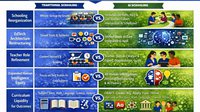
Yet the shift is even bigger than the teacher’s role alone. AI challenges the entire operational logic of schooling, including how time, groups, and workflows are structured. The legacy whole‑group‑by‑the‑hour model is no longer efficient, equitable, or aligned with how intelligence—human and artificial—actually works.
- Designing learning as a Human Catalyst
Rather than delivering content, teachers become learning designers who integrate AI visibly and intentionally into the process. This includes prompt crafting, critiquing AI outputs, teaching discernment, and requiring students to document their own thinking alongside AI‑assisted work. This shift demands training and clarity that many educators report as lacking: surveys show insufficient AI training and ongoing policy gaps, with fewer than half of schools having formal AI guidelines as of 2025. [img.datiak12.io], [thejournal.com]
- Diagnosing understanding through truly human‑only signals
As AI handles routine production tasks, teachers focus on verifying authentic understanding using methods AI cannot fake: oral defenses, live problem‑solving, iterative artifacts, and cognitive explanations. Research across faculty groups calls for new assessment models that protect academic integrity while embracing AI as part of learning. [cerritos.edu]
Beyond the Teacher: AI as a Workflow Orchestrator for the Whole System
The transformation extends far past instructional design. AI enables a complete re-architecture of school operations, using agents to manage time, grouping, sequencing, and support with unprecedented precision.
- AI agents can coordinate school workflows end‑to‑end
Instead of relying on manual scheduling, static pacing guides, or ad‑hoc teacher adjustments, AI can continuously manage:
- student progress tracking
- task assignment
- intervention timing
- parent communication
- resource matching
- micro‑group formation
This shifts schools away from rigid blocks of time and toward distributed, dynamic, responsive learning flows—something teachers have long lacked the capacity to manage manually. Educators already identify workload and support gaps as barriers to using AI effectively. [michiganvirtual.org] - AI can manage learner and teacher time more precisely than whole‑group lessons
The traditional “30 students, one hour, one lesson” model becomes optional. AI can tailor time based on mastery, readiness, or need—accelerating some learners, slowing down others, and surfacing real‑time data for teachers. This directly addresses the lack of time educators report when attempting to differentiate instruction at scale. [michiganvirtual.org]
- AI can dynamically form and reform student groups
Instead of fixed cohorts held together by schedules and bells, AI can cluster students based on real‑time indicators—struggle patterns, task similarity, learning style, or needed support—giving teachers far more accurate windows for targeted human intervention.
- AI can orchestrate personalized learning pathways automatically
With continuous mastery checks, AI can recommend next steps, adjust difficulty, detect misconceptions, and surface actionable insights. Teachers then act as expert diagnosticians, using human judgment to interpret complex cases, address emotional and motivational factors, and guide learners toward deeper understanding.
Until schools redesign not only the teacher’s role—but also the operational workflow that surrounds it—AI will continue to feel like a threat rather than a lever. When teachers are positioned as Human Catalysts, Expert Diagnosticians, and Guides, supported by AI systems that manage time, tasks, and workflow, the profession becomes more human, not less—and schooling becomes far more relevant, resilient, and future‑ready.
The Equity Angle: Uneven Guidance Widens the Gap
AI’s promise isn’t distributed evenly—and current adoption patterns risk widening gaps. A national snapshot from RAND found that only about one‑quarter of teachers used AI for instructional planning or teaching in 2023–24, with significant variation by subject and school poverty level; principals reported limited guidance, especially in higher‑poverty schools. Similar statewide and sector studies show that policy clarity and professional learning are decisive factors in uptake, with skeptical or resistant subgroups clustering where institutional support is thinnest. [rand.org] [michiganvirtual.org], [devdiscourse.com]
In other words: absent role redesign, clear guidance, and operational workflow changes, AI can increase variability across classrooms and communities—precisely the opposite of what public education intends.
The longer we remain role‑misaligned, the more we cement an AI equity divide. [rand.org], [michiganvirtual.org] [devdiscourse.com]
What must change (beyond roles): center the human and re‑platform the curriculum
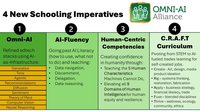
- Adopt universal awareness of the 9 Human Intelligences across all educators and learners.
The Learning Counsel’s research and writing call for schools to develop all nine human intelligences (not just linguistic and logical‑mathematical), reframing learning goals to elevate capabilities machines cannot replace. By itself the catering to just two of the nine intelligences has created a vast inequity still propagated to this day. See: Developing the Human Co‑Intelligences to Balance AI and the book‑anchored overview The Human Singularity (which introduces the “Cauthen 9 Human Intelligences” and why they were revised from Gardner’s list).
→ Recommended primer for staff PD and student advisory: “The New Education Imperative: The 9 Human Intelligences Revised for the Age of AI” (featured by Learning Counsel). [thelearnin...ounsel.com], [thelearnin...ounsel.com] [thelearnin...ounsel.com]
- Move away from siloed subjects; “matrix” the basics beneath a CRAFT curriculum.
Rather than running isolated disciplines hour‑by‑hour, organize the basics (literacy, numeracy, data/time awareness, etc.) as matrixed foundations under CRAFT—Create • Rig • Apply • Fuse • Thrive—so learners build human intelligences through authentic, hands‑on, and entrepreneurial work. See CRAFT is the New STEM Converse for the full pillar definitions and outcomes.
For leaders designing this shift, Crafting a Learning Matrix explains how to orchestrate time, space, teachers, resources, and digital logistics so students operate as independents within a coordinated enterprise (i.e., a matrix), not as one‑size cohorts. [thelearnin...ounsel.com] [thelearnin...ounsel.com]
- Replace “whole‑group‑by‑the‑hour” with time‑orchestrated, agent‑assisted workflows.
Precision equity requires control of when learners intersect with content, how long they remain with a concept, and when they meet peers/teachers—beyond fixed bells. See The Irreversible Transformation of Education: From Factory‑Mode Learning to Time‑Orchestrated, Pace‑Based Intelligence (Learning Counsel).
Practically, tools like Time AI automate auto‑cohorting and dynamic micro‑scheduling (meetings that “float” until a cohort fills, then set automatically), fractionalizing traditional classes into right‑sized, right‑time human moments—freeing teachers to be Human Catalysts, Diagnosticians, and Guides.
For district‑scale architecture, the Omni‑AI Alliance outlines AI‑as‑infrastructure (governable cores across LMS/SIS/curriculum/operations) to ensure secure, equitable orchestration with humans in the loop. [thelearnin...ounsel.com] [thelearnin...ounsel.com] [thelearnin...ounsel.com]
Equity won’t come from tools alone. It comes from re‑centering human intelligences, matrixing the basics beneath a curriculum ideology like CRAFT, and re‑platforming time and workflow so every learner gets timely, authentic human teaching—at scale. [thelearnin...ounsel.com], [thelearnin...ounsel.com], [thelearnin...ounsel.com], [thelearnin...ounsel.com], [thelearnin...ounsel.com]
Why This Is the First Point of Address If Schools Want to Stop Their Own Decline
1) Relevance Requires Role Realignment
Students already live and work with AI. Surveys show widespread student use for study support, drafting, and explanation. If school tasks ban or ignore the tools of the world, schools become less credible learning environments. Relevance returns when teachers are empowered and expected to teach with AI—curating, constraining, challenging, and coaching its use with purpose. [sites.campbell.edu]
2) Integrity Requires Assessment Redesign
You cannot “police” your way out of a measurement problem. Detection tools help, but the durable fix is assessment that captures human reasoning, transfer, and decision‑making, making AI a documented collaborator rather than a contraband accomplice. Faculty demand exactly this shift. [cerritos.edu], [frontiersin.org]
3) Teacher Time Requires Workflow Redesign
Educators report AI’s time‑saving benefits when properly supported—drafting communications, planning lessons, translating text, and analyzing data—yet the benefits scale only when training and policies remove ambiguity and risk. National and sector reports show growing usage and optimism paired with persistent concerns and gaps in guidance. [discover.c...arning.com], [cdn-dynmed...rosoft.com]
Redefining the teacher role to use AI for planning and differentiation while preserving human judgment for relationships and verification directly addresses workload pressure, integrity worries, and equity gaps.
What Redefinition Looks Like (Practical, Near‑Term)
1. From Content Deliverer → Learning Designer
- Design visible AI‑use protocols (e.g., students attach prompt history, drafts, and reflection to any AI‑assisted submission). This reframes AI from hidden shortcut to assessable process. Faculty and integrity research specifically call for clearer guidelines and educative approaches, not just punitive ones. [frontiersin.org]
2. From Assignment Grader → Evidence Verifier
- Use oral defenses, live problem‑solving, and micro‑vivas after AI‑assisted work. Instructors cite the need for innovative assessment approaches to meet integrity challenges. [cerritos.edu]
3. From Solo Planner → AI‑Accelerated Curator
- Leverage AI for drafting parent communications, scaffolds, and differentiated materials, then human‑edit. Surveys show educators already see these as the biggest benefits when they do adopt AI. [thejournal.com], [discover.c...arning.com]
4. From Policy Follower → Policy Co‑Author
- Codify acceptable use in syllabi and school handbooks: where AI is required, allowed, or restricted—and why. District and national snapshots reveal too many schools without clear policy, a key barrier to responsible adoption. [thejournal.com]
5. From Gatekeeper of Knowledge → Coach of Judgment
- Teach prompting, skepticism, and source triangulation. Multiple surveys show worry about over‑reliance and loss of critical thinking; the antidote is to assess the thinking that surrounds AI use. [turnitin.com]
Leadership Imperatives: Change the Job, Not Just the Toolset
- Redefine Roles in Contracts & Handbooks. Explicitly state expectations for AI‑integrated design and verification work—then schedule time for it. (If it isn’t in the schedule, it isn’t in the job.) Surveys indicate teachers lack time and training, suppressing uptake even when attitudes improve. [img.datiak12.io], [michiganvirtual.org]
- Adopt Clear, Tiered AI Policies. Require transparent AI process documentation for certain tasks, allow constrained use for others, and restrict when necessary—paired with reasoning students can understand. The absence of policy correlates with inconsistent practice and heightened concern. [thejournal.com]
- Invest in Professional Learning Focused on Assessment Redesign. Anchor PD in performance tasks, oral defenses, and portfolio evidence that AI can support but not replace. Integrity research shows faculty prefer educative approaches and need guidance to update practice. [frontiersin.org]
- Monitor Equity. Direct more support to high‑poverty schools where guidance and adoption lag. RAND’s national analysis underscores these gaps—and the risk of widening inequities without intentional investment. [rand.org]
The Payoff: From Defensive Posture to Strategic Advantage
The past two years delivered a split‑screen: rising use and optimism about AI’s potential to reduce busywork and personalize learning, alongside rising concern about cheating, privacy, and readiness. The split is not paradoxical—it’s diagnostic. Where roles, policies, and assessments remain pre‑AI, the technology feels like a threat. Where they are updated, AI becomes a force multiplier for teacher judgment, time, and human connection. [discover.c...arning.com], [cdn-dynmed...rosoft.com]
If schools want to remain relevant—and halt a slow drift toward external alternatives—they must fix the role definition first. Update what we count as teaching and evidence of learning, and AI stops being the Achilles heel. It becomes the lever that lifts relevance, integrity, and equity together.
Sources (selected)
- RAND (2025): Uneven adoption of AI among U.S. teachers and principals; guidance gaps and disparities. [rand.org]
- THE Journal survey (2025): 78% of educators worried about AI‑enabled cheating; >60% have experienced it. [thejournal.com]
- Inside Higher Ed / Wiley (2024): Students and professors expect more cheating due to AI; 47% of students say cheating is easier. [insidehighered.com]
- EdSource (2026 brief): Summarizes survey indicating expectations of increasedcheating with AI. [edsource.org]
- Michigan Virtual (2025): Usage growth outpacing trust; systemic supports lag. [michiganvirtual.org]
- DATIA K12 Survey (2024): Adoption interest high; 59% cite lack of training asmajor risk; 62% still planning guidelines. [img.datiak12.io]
- AIPRM compilation (2024): ~21% of teachers hold negative views of AI in education (selected stat among multiple). [aiprm.com]
- Faculty perspectives on role and integrity challenges; need for innovative assessment and educative approaches. [cerritos.edu], [frontiersin.org]
- Turnitin/Vanson Bourne (2025): Students feel they may be shortcutting learning; demand for clear guidance. [turnitin.com]
- Microsoft Special Report (2025): Growing examples of structured, responsible AI use improving inclusion and efficiency. [cdn-dynmed...rosoft.com]
- Developing the Human Co‑Intelligences to Balance AI (9 intelligences) [thelearnin...ounsel.com]
- The Human Singularity (book; “Cauthen 9 Human Intelligences”) [thelearnin...ounsel.com]
- CRAFT is the New STEM Converse (CRAFT pillars) [thelearnin...ounsel.com]
- Crafting a Learning Matrix (matrixing time/space/resources) [thelearnin...ounsel.com]
- The Irreversible Transformation of Education: From Factory‑Mode… (time‑orchestrated model) [thelearnin...ounsel.com]
- What is Time AI? (auto‑cohorting, fractionalized time) [thelearnin...ounsel.com]
- Omni‑AI Alliance (AI‑as‑infrastructure, governance) [thelearnin...ounsel.com]