For many educators, artificial intelligence is still understood primarily as a tool—something that assists lesson planning, generates assessments, or personalizes practice activities. While these uses have value, this framing fundamentally misses what AI is about to transform.
The real impact of AI in education is not instructional support, but the reorganization of time, grouping, and instructional logistics at scale.
The future of learning will not be defined by better content creation. It will be defined by a structural disaggregation of learning into its essential components, followed by a reassembly governed by time-aware intelligence. This transformation is not optional, experimental, or philosophical. It is inevitable, because the current system is no longer logistically sustainable.
The Core Failure of the Factory Model
Modern schooling still operates on an industrial design inherited from the early twentieth century. Students are grouped by age, taught on fixed schedules, and expected to progress through material at a uniform pace. Teachers are assigned to deliver instruction to entire groups in synchronized time blocks, regardless of wide variations in readiness, background knowledge, or learning speed.
As expectations for personalization have increased, this structure has collapsed under its own weight. Teachers are now asked to teach mixed-ability groups in real time while simultaneously differentiating instruction, providing remediation and enrichment, and designing multiple lesson variations for every major concept. This is not a failure of teacher preparation or commitment. It is a structural impossibility.
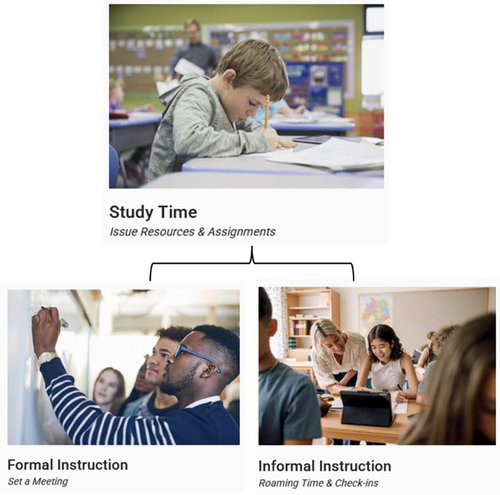
No single live lesson can effectively serve learners who are behind, on pace, and ready to advance at the same time without reducing learning quality for everyone involved. The system forces compromise where precision is required.
Why More Tools and More Content Do Not Solve the Problem
Generative AI has exposed the limitations of the existing model even more clearly. While it can produce unlimited lesson variants, explanations, and practice materials, it actually increases complexity if the underlying delivery model remains unchanged. Teachers become overwhelmed curators of abundance, responsible for managing infinite possibilities within a fixed instructional window.
Personalization, in its meaningful sense, is not about the number of lesson versions available. It is about control of time. It is about when a learner encounters instruction, how long they remain with a concept, and when they meaningfully intersect with others.
Time has been treated as fixed and unchangeable in schooling. In reality, it is the most critical variable in learning—and the least intelligently managed.
The Missing Layer: Time as an Intelligent System
The true transformation in education emerges when time itself becomes an intelligent, adaptive layer in the learning system. This is where Time AI operates in concert with Generative AI.
Generative AI supports content delivery, explanation, feedback, and practice. Time AI governs pacing, sequencing, grouping, and synchronization. Together, they allow learning to occur asynchronously without isolating learners from live instruction or social interaction.
In this model, students are no longer required to be in the same place in the curriculum at the same moment. Instead, they progress independently through instructional components at their own pace. Time AI continuously analyzes progress, readiness signals, and learning momentum, identifying optimal moments for live interaction.
Fractionalization of Learning: Ending Whole-Group Dependency
A foundational shift enabled by Time AI is the fractionalization of learning. Learning is separated into its functional components: concept acquisition, practice and reinforcement, assessment of readiness, application, and discussion. These elements no longer need to occur simultaneously or within permanent groups.
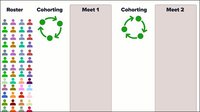
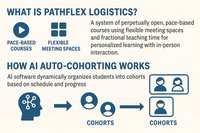
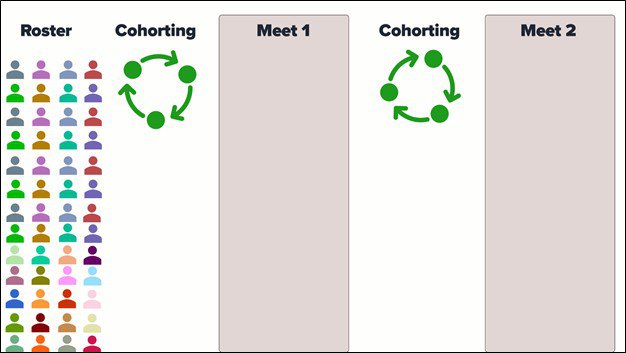
Learners move asynchronously through instructional material until they reach natural convergence points, where discussion, collaboration, demonstration, or coaching is most effective. At those points, Time AI dynamically forms temporary cohorts of learners who are aligned in readiness and need.
Live teaching becomes targeted and high-impact rather than generalized and diluted. Teachers engage learners when instruction can truly land, rather than broadcasting to a wide readiness spectrum.
Asynchronous-to-Synchronous Learning as the New Instructional Spine
This model replaces rigid schedules with an asynchronous-to-synchronous learning flow. Asynchronous learning absorbs variability in pace, prior knowledge, and learning speed. Synchronous learning is reserved for moments of meaning-making, problem-solving, discussion, and human connection.
Socialization does not disappear. It becomes intentional. Students collaborate with peers who are cognitively aligned at that moment, rather than arbitrarily grouped by age or seat assignment. Community is preserved without sacrificing individual progress.
A Practical Description of Time AI in a Real Learning System
In practice, Time AI operates as a multi-layered orchestration system rather than a simple scheduling tool. In the Knowstory model, Time AI functions across individual, course, and system-wide layers simultaneously.
At the individual level, each learner maintains a continuously adjusting schedule driven by their pace of progress, mastery signals, and availability. Time AI recalibrates what a learner should work on next, when live interaction is most beneficial, and how learning time is allocated across subjects.
At the course level, Time AI auto-cohorts learners based on readiness and momentum rather than enrollment dates or fixed rosters. Live class meetings are dynamically scheduled by the AI when sufficient alignment exists among learners for high-value interaction. These class meets can occur virtually or in person, with location-aware logic that accounts for geography, campus availability, and teacher presence.
At the system level, Time AI manages master scheduling across teachers, rooms, campuses, and remote environments. Teacher time is fractionalized, allowing educators to serve multiple cohorts across different locations without being bound to a single fixed class. The system continuously optimizes resource use while preserving instructional quality.
The result is a living schedule that adapts in real time, rather than a static calendar that forces learning to conform to institutional constraints.
What This Means for Educators
In a time-orchestrated system, educators are not replaced. They are finally supported by a structure that matches the realities of learning. Teachers no longer carry the impossible burden of meeting all learner needs simultaneously.
Their role shifts toward designing learning pathways, facilitating high-quality live interactions, mentoring learners at critical moments, and applying professional judgment where it matters most. The system absorbs logistical complexity so teachers can focus on intellectual and relational work.
An Irreversible Direction
This transformation will occur regardless of institutional readiness. Learners and families are already experiencing time-adaptive, AI-driven learning outside of school systems. Education can either lead this transition deliberately or be overtaken by it.
The factory model cannot be incrementally improved into relevance. It must be replaced by a time-intelligent learning system where pace, readiness, and human connection are finally aligned.
That is the real future of education.
Reference: Knowstory is an advanced Time AI platform designed to revolutionize how schools manage learning. It uses intelligent automation to dynamically cohort students, optimize schedules, and align resources around course-centric digital learning with live teaching. Knowstory creates a fluid, personalized educational experience that adapts to each learner’s pace with learning pathways, enabling schools to maximize efficiency, matrix engagement across multiple campuses, and increase achievement.